Flexible savings explained: Add, earn daily, withdraw when you need it

Some of your money is just waiting: a rent payment due in six weeks, a cushion so a market dip doesn't force you to sell. It doesn't have to sit idle, and it doesn't have to be locked away either.
Flexible crypto savings are built for exactly that. You add crypto or stablecoins, interest accrues every day, and you withdraw whenever you need to. There's no end date and no countdown.
This guide explains how it works, what a variable rate means, and when flexible is the wrong choice.
TL;DR
- Flexible savings are for money that’s waiting. You add crypto or stablecoins, earn interest daily, and take it out whenever you want. There’s no lock-up.
- The rate is variable. It can move up or down, but a change never touches interest you’ve already earned.
- Withdrawals aren’t instant, so ask a day or two early if you need the money by a certain date. Minimums depend on the asset, and the app shows them.
- It isn’t a bank account. Rates can fall, and a volatile coin can lose value faster than interest can make up for.
- Pick flexible if you don’t know when you’ll need the money, and fixed if you won’t touch it for months. Plenty of people use both.
What are flexible crypto savings products?
Flexible savings let you earn interest on idle crypto without leaving it untouched for a set period. You can add more and withdraw whenever you like, within the app's processing time.
The main alternative is fixed-term savings. You pick a term, typically between one month and one year, and your balance stays put until it ends. In return, your rate is locked in. Flexible gives up that certainty in exchange for freedom.
If you've used a regular current account and a notice account at a traditional bank, it's a similar split. One is for money you might need next week. The other is for money you've already decided to set aside.
Flexible savings work with both crypto and stablecoins, but the two behave differently, and what assets you can use depends on your country:
- Stablecoins like USDC are designed to track a real-world currency, so your balance is easy to reason about. A rent fund in USDC should still be worth roughly the same next month, though no stablecoin is guaranteed to hold its peg.
- Coins like BTC or ETH can move a lot in price. Interest doesn't change that. You still watch the value of your holding rise or fall, and interest only softens a drop or adds a little to a gain.
How it works: Add, earn, withdraw
1. Add crypto or stablecoins
Choose an asset and an amount, then move it into Flexible Savings. Each asset has its own minimum. For USDC it's currently the equivalent of 10 USD, and the app shows the others before you confirm.
You don't have to move everything. Many people keep part of their holdings in their wallet for trading or spending and put only the waiting money to work.
2. Watch the interest build
Once your balance is in, interest accrues daily and shows up in the app. If you're curious about the mechanics, how daily interest adds up is a quick read.
A few days of interest won't change your month, but weeks and months can.
Say you add 10,000 USDC at an example rate of 5.2% APY. You'd earn about 1.39 USDC on the first day, and roughly 520 USDC over a year if the rate stayed the same. For comparison, 10,000 USDC in Fixed Savings at 8.2% APR would earn about 820 USDC over 12 months. Both figures are examples, not current offers.
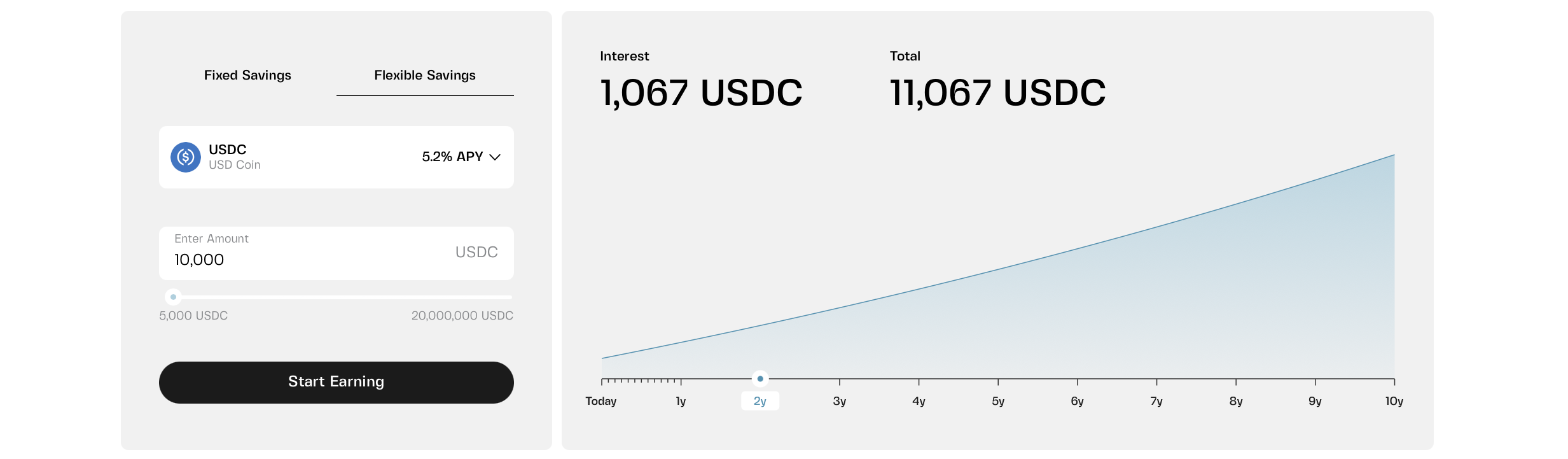
Why two different labels? Flexible Savings rates are shown as APY because interest is added on top of earlier interest. APR doesn't include that effect. If the labels confuse you, APR vs. APY explains why the same rate can look slightly different depending on which one is shown.
3. Withdraw when you need it
Tap the withdrawal button in the app and your balance plus the interest you've earned comes back to you. Processing may take a short while rather than being instant, so if you have a payment due on a specific day, request the withdrawal a little ahead of time.
What a variable rate means
Flexible savings pay a variable rate, so what you see today is a snapshot, not a promise. In practice:
- The app always shows the current rate for each asset.
- If the rate changes, the new rate applies from that point on. It doesn’t reach back and change interest you’ve already earned.
- The rate you see this week may not be the rate you see in two months.
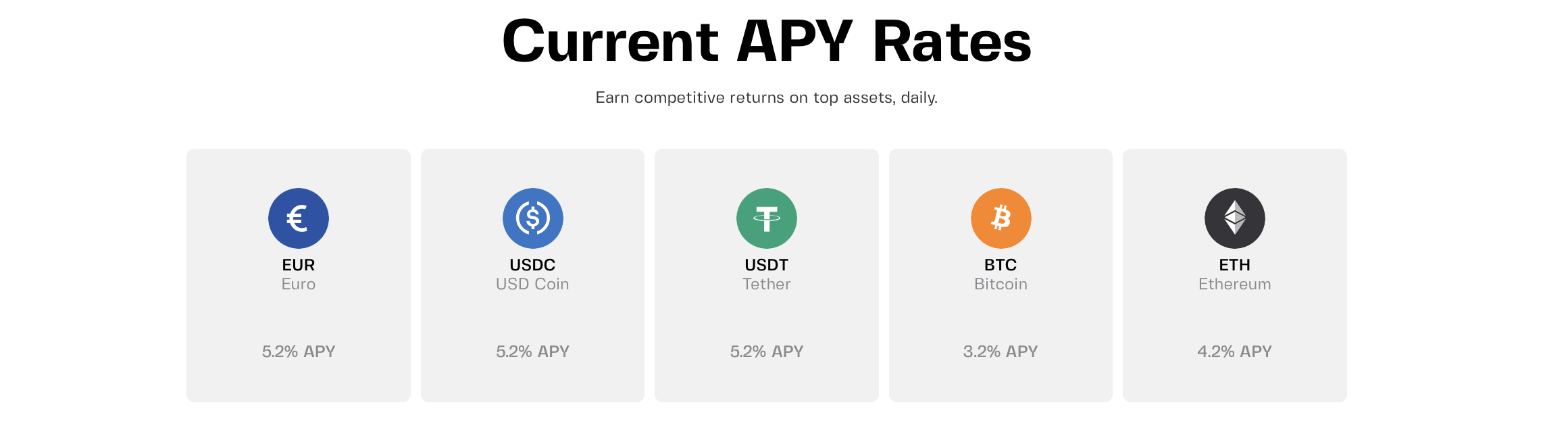
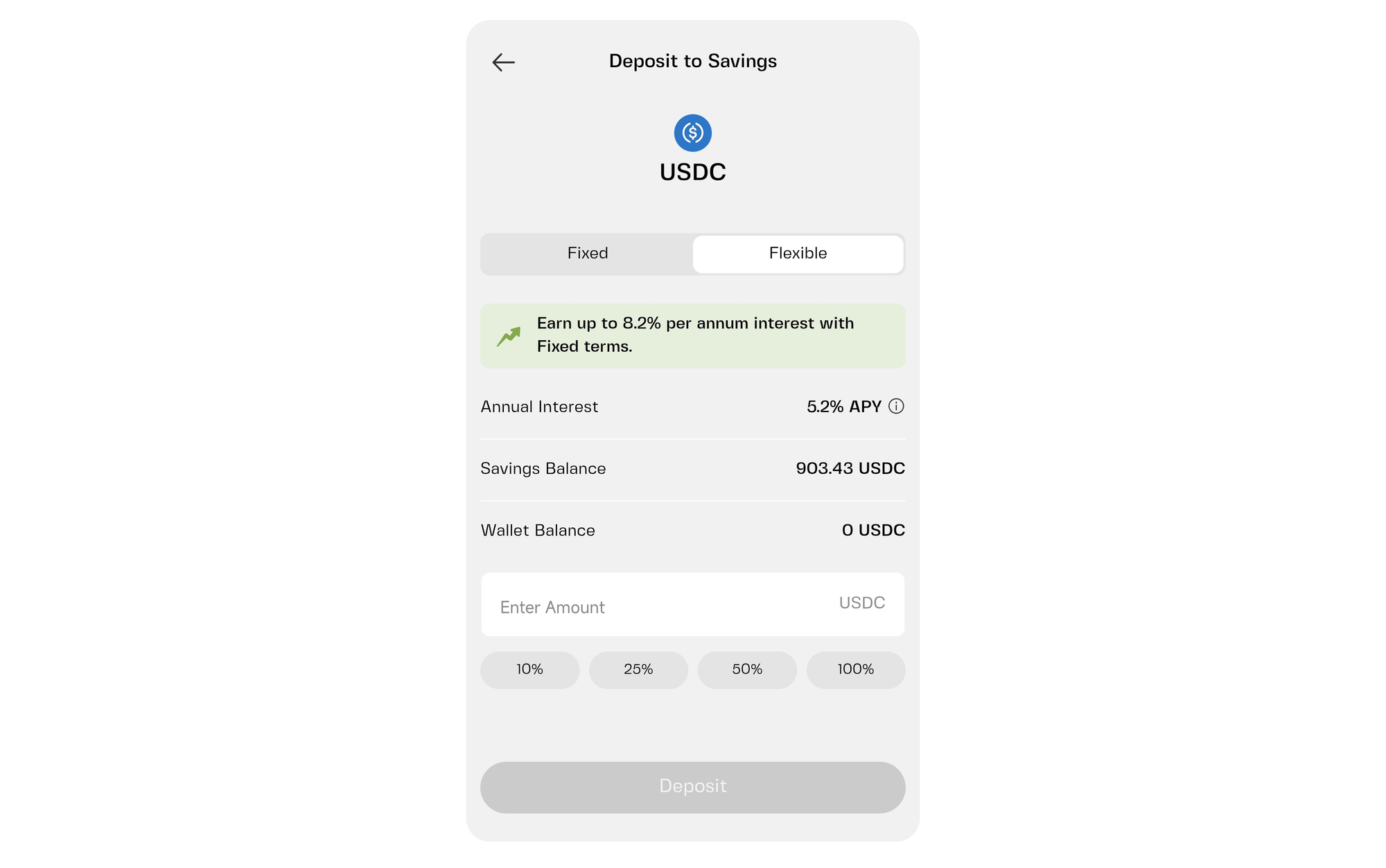
Right now, the highest flexible rate in the Clapp app is 5.2% APY, applied to stablecoins (USDT and USDC) and fiat (EUR), while ETH and BTC earn 4.2% and 3.2%, respectively.
The catch is that you can’t plan around an exact figure. The upside is that you’re never stuck: if the rate drops and you’d rather use the money elsewhere, you can move it.
Minimums and withdrawals
Minimums
Every asset has a minimum amount to add, shown in the app. Withdrawals can have a minimum too, and it depends on the asset.
If you're wondering whether a small amount is worth it, our guide to how much you need to start has real earnings examples. Put simply, modest balances earn modest amounts, but starting small is a perfectly good way to see how it feels.
Withdrawals
Every asset has a minimum amount to add, shown in the app. Withdrawals can have a minimum too, and it depends on the asset. If you're wondering whether a small amount is worth it, our guide to how much you need to start has real earnings examples. Put simply, modest balances earn modest amounts, but starting small is a perfectly good way to see how it feels.
- Allow for processing. Requests are handled within the app's processing time. That's quick for most users, but not necessarily instant.
- Check the minimum. If your balance is close to the withdrawal minimum, you may need to take out a little more than you planned.
- Build in a buffer for big purchases. If you need the money by a certain date, request it a day or two earlier than you think you need to.
Risk
Flexible savings aren't a bank deposit and aren't covered by a deposit guarantee scheme, and they carry risk. Rates can fall, and if you hold a volatile coin, the interest you earn may not offset a price drop. Only add what you'd be comfortable seeing move around.
When flexible fits, and when it doesn't
Neither flexible nor fixed is better by default. The choice comes down to when you might need the money, and our deep dive into flexible versus fixed savings goes further. The short version is below.
Flexible makes sense when:
- You don't know when you'll need the money. An emergency fund, a deposit for a flat you haven't found yet, medical bills, or a holiday with no date.
- You want to stay ready for the market. If you're holding stablecoins to buy a dip, you don't want them locked up when the moment comes.
- You're new and want to try it. Test the process with a small amount and no long commitment.
- You expect to top up often. You can add small amounts as you go.
Flexible is the wrong pick when:
- You won't touch the money for months. If you already know it's staying put, you're paying for unused flexibility. Fixed-term savings is the better match, since you lock in your rate for the term.
- You want to know your exact return in advance. A variable rate can't give you that.
- You're tempted to dip in. If easy access makes you spend, a term with a set end date can work as a guardrail.
Many people use both: a flexible pot for the maybe-soon money and a fixed-term pot for the definitely-later money.
Flexible vs. fixed, in a nutshell
Flexible crypto savings is the everyday option: add crypto or stablecoins, watch interest build daily, and withdraw when you need to. The price of that freedom is a variable rate that can drop, so you can't count on a fixed return the way you can with a term.
If your timing is uncertain, it's a sensible place for money that's waiting. If you already know you won't need the money for months, a fixed term may suit you better. Either way, start with an amount you're relaxed about, check the rate in the app, and adjust as you go.
Frequently asked questions
What is flexible savings?
It lets you earn interest on crypto or stablecoins without a fixed term. You can add more and withdraw when you need to, within the app's processing time. The rate is variable, so it can change.
How often is interest added?
On Clapp, interest accrues daily, and you can follow it in the app day by day. Accrual rules on other platforms may differ.
Can the rate change?
Yes. The rate is variable and can move up or down. The app always shows the current rate for each asset, and any change applies going forward, not to interest you've already earned.
How quickly can I withdraw?
You can request a withdrawal at any time and it's handled within the app's processing time. If you need funds by a specific date, request them a little early. Withdrawals may have a minimum, which the app shows.
Is flexible or fixed better?
It depends on your timing. Flexible suits money you might need soon or at an unknown date. Fixed suits money you won't touch for a set period, because you lock in your rate for the term.
Does flexible savings carry risk?
Yes. Rates can fall, and crypto prices can move up or down. Interest doesn't remove price risk. Only add an amount you're comfortable with.